How to Track Calories in Arabic Food: A Practical Guide for Kabsa, Saloona and Family Platters
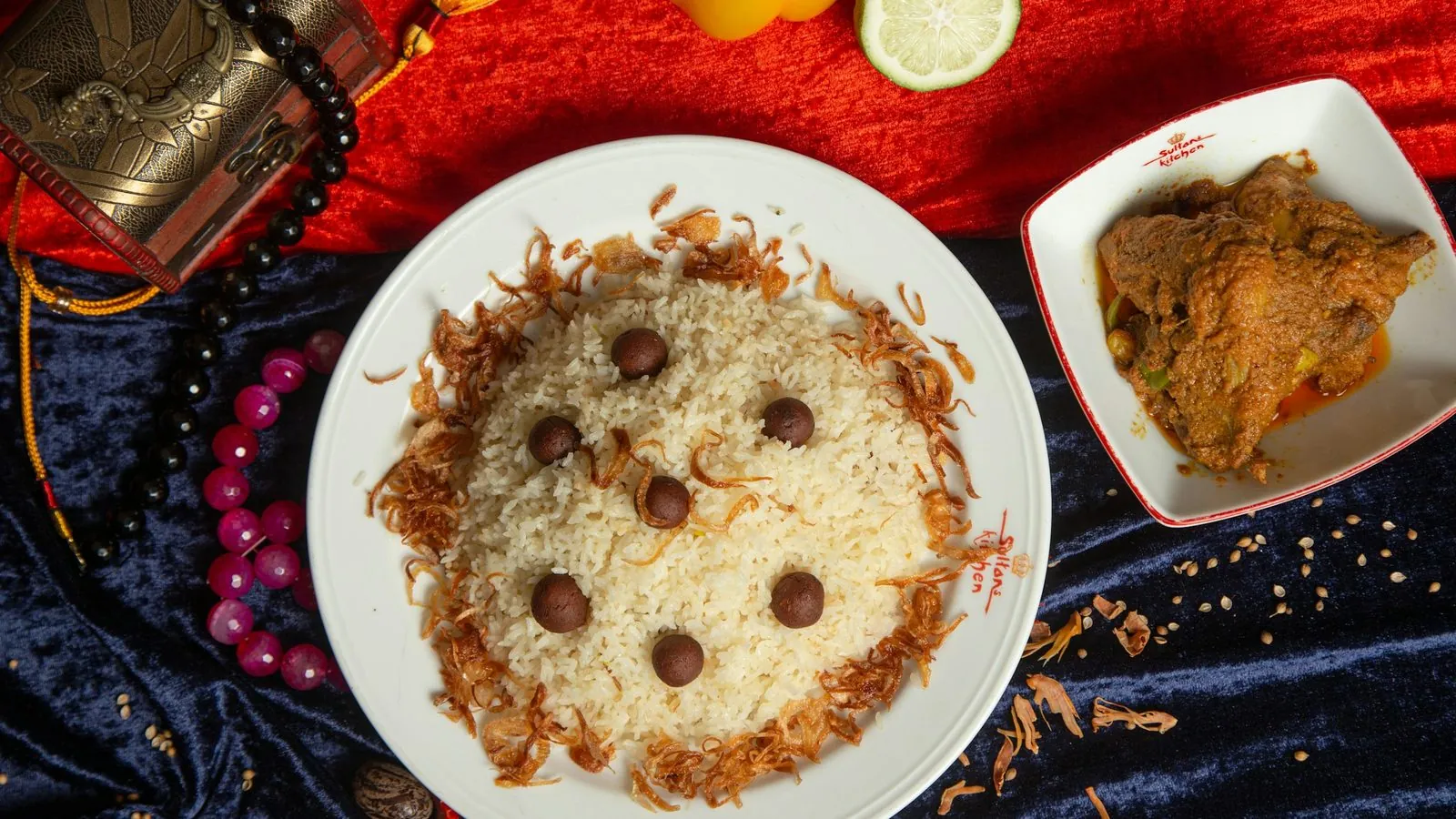
Photo by Shourav Sheikh on Unsplash
Use a different method for different meals. Packaged food: read the label. Restaurants in Saudi Arabia: use the calories printed on the menu. Home-cooked dishes like kabsa or saloona: work out the whole pot once, then weigh your plate. A photo scan is a quick start, but check the portion and add the oil and drinks it can't see. Close enough, most days, is plenty.
- Restaurant menus in Saudi Arabia have to show calories, so use them.
- For a family recipe, calculate the pot once and reuse it.
- Oil, ghee, dates with coffee and sweet tea are the things people forget to log.
- A scan is an estimate. Check it before you save it.
- If tracking makes you anxious, stop. It's one tool, not a rule.
Most calorie apps seem to have been designed around a sandwich, a protein bar and a chicken breast on a kitchen scale. Our food isn't like that.
Kabsa is one pot: rice, meat, onion, tomato, spices, ghee, sometimes nuts and raisins. Lunch at your mother-in-law's comes on a shared tray. And no two people make saloona the same way.
So when people tell me "I tried tracking but I didn't know what to type," I completely understand. This post is for exactly that moment. If you'd rather not count at all, the balanced Saudi plate guide shows you how to portion with your hand, and Macros Made Simple covers protein, carbs and fat. Today is for when you do want a number.
Why our food is harder to log
A one-pot dish has no single entry to search for. A shared platter hides how much you actually ate. And recipes vary a lot from home to home, mostly because of the fat.
That last part matters more than people expect. USDA data puts olive oil at about 119 calories a tablespoon, and ghee is almost pure fat, at roughly 900 calories per 100 g. Two extra spoons in the pot changes the whole dish.
Then there are the small things. Arabic coffee with dates. A cup of karak. A handful of nuts at a majlis. None of them feel like "eating", which is why they rarely make it into the diary.

Match the method to the meal
Packaged food: the label
For anything in a packet, the label is your most reliable number. Check the serving size before anything else. If the packet says 30 g per serving and you ate the whole 90 g bag, that's three servings.
Restaurants and cafés: the menu
In Saudi Arabia this part is easier than in many countries. The Saudi Food and Drug Authority (SFDA) requires food businesses to show calories next to each item on their menus, including electronic menus and the delivery platforms they work with. Sides and add-ons are listed separately, and the same dish cooked two ways (grilled or fried chicken, say) gets its own figure. Since July 2025, SFDA rules also require a salt icon on menu items with more than 5 g of salt.
So log the menu number. Then be honest with yourself. Extra sauce? Shared the fries? Change the entry.
Home cooking: the whole-pot method
This works for any one-pot dish, and it's the one I'd learn first.
- Add up what goes into the pot: rice, chicken or meat, onions, tomatoes, oil or ghee, nuts. Look each one up once.
- Weigh the cooked dish. Weigh the empty pot first, or move the food into a container you've already weighed.
- Divide total calories by cooked weight. That gives you calories per gram.
- Weigh your plate and multiply.
An illustrative example, not a lab value: say your kabsa ingredients come to 4,800 calories and the cooked kabsa weighs 3,200 g. That's 1.5 calories per gram, so a 350 g plate is about 525 calories.
The first time takes maybe ten minutes. After that the recipe is saved. Most nights you'll just weigh your plate, or remember roughly what your usual plate comes to.
Work out the pot once. After that, you only need your plate.

Family platters: estimate your share
You can't weigh a shared tray. You can make it easier to see what you ate, though.
Put your portion on a plate first, even a small one. Count in units you can repeat, like two scoops of rice or one piece of chicken. And log the rice and the meat as separate items rather than "one plate of kabsa". It's usually closer.
A photo scan: quick, then check
Photo logging saves a lot of typing. It's also an estimate, and the research is clear about that. A 2023 systematic review of AI image-based dietary assessment found average calorie errors anywhere from 0.1% to 38%, with better results for simple single foods than mixed meals (Shonkoff et al., 2023). A 2024 study comparing apps found automatic photo estimates were often off for mixed dishes and culturally diverse foods (Li et al., 2024).
That's not a reason to skip scanning. It's a reason to check. Confirm the dish and the portion. Then think about what the camera can't see: oil in the rice, ghee on top, sugar in the tea. Edit, then save.
In Byondbites you can scan a meal to log its calories. Treat the result as a first draft and adjust the portion. It's still quicker than scrolling a long list for "rice with chicken".
The things people forget
These are the gaps I see most often in food diaries here.
| Often forgotten | Why it matters | Quick fix |
|---|---|---|
| Cooking oil and ghee | Small amounts carry a lot of energy (olive oil is about 119 calories per tablespoon, USDA) | Measure with a spoon instead of pouring |
| Dates with coffee | One Medjool date (about 24 g) is roughly 66 calories, USDA | Count them like any other snack |
| Karak, sweet coffee, juice | Liquid sugar adds up and doesn't fill you | Log every cup, or swap some for water |
| Bread on the side | Easy to add to a rice meal without noticing | Pick one carb for the meal |
| Nuts and sweets at gatherings | Handfuls are hard to count | Put a small portion on a plate |
| Sauces and dips | Tahini, garlic sauce and mayonnaise are rich in fat | Ask for them on the side |
Calorie figures are approximate examples from USDA FoodData Central and vary by product and portion.

How accurate do you need to be?
Less than you'd think. Research on self-monitoring shows a consistent link between regularly tracking what you eat and better weight-management results, though the authors note the evidence has limits (Burke et al., 2011). What seems to help is the awareness and the habit, not a perfect number.
So log most meals, most days, even roughly. Estimate the same way each time, so your trends still mean something. And look at the week rather than one heavy dinner.
As a working mum, I'll be honest: I don't know many people who weigh every plate, every night, for months. You don't need to.
When tracking isn't the right tool
Counting calories suits some people and not others. A study of university students linked calorie tracking with more eating concerns and dietary restraint in some users (Simpson & Mazzeo, 2017). If tracking leaves you anxious or guilty, or you can't stop thinking about food, put it down and go back to something simpler, like the hand method.
If you have diabetes or kidney disease, are pregnant, or have a history of disordered eating, follow your doctor's or healthcare team's guidance rather than general targets.
Three things to try this week
- Save one family recipe using the whole-pot method.
- Log one restaurant meal straight from the menu.
- For three days, measure your cooking oil with a spoon and log it.
FAQ
How do I count calories in kabsa?
Add up the calories of everything that goes in, weigh the cooked kabsa, and divide to get calories per gram. Then multiply by the weight of your plate. Save it and you can reuse it every time.
Are photo calorie scanners accurate for Arabic food?
They give a useful estimate, not a measurement. Errors are bigger for mixed dishes, so check the portion and add any oil, ghee or sauce the photo can't show.
Do restaurants in Saudi Arabia show calories?
Yes. SFDA rules require food businesses to show calories next to menu items, including on electronic menus and the delivery platforms they work with.
What if I eat from a shared platter?
Put your portion on a plate first, count in simple units like scoops and pieces, and log the rice and the protein separately.
Do I have to track calories to eat healthily?
No. Plenty of people do well with portion guides instead. It's fine to track for a few weeks to learn, and then stop.
The bottom line
You don't need the perfect number for your mother's kabsa. You need the right method for each meal, used most days. That alone will teach you more about how you eat than any single perfect entry.
Want a simpler start?
Scan your next meal in Byondbites to log it. Or book a free 30-minute consultation with me, and we'll work out an approach that fits the way your family eats.
Available on the App Store and Google Play
Sources and further reading
- Saudi Food and Drug Authority (SFDA). Guide to the requirements for displaying calories on the menus of food establishments (Arabic). sfda.gov.sa
- SFDA (2025). The SFDA issues three new regulations to promote healthy community nutrition (salt, caffeine and activity labelling). sfda.gov.sa
- SFDA (2026). SFDA launches Saudi Food Composition Database. sfda.gov.sa
- USDA FoodData Central. Oil, olive, salad or cooking (FDC 171413); Butter, clarified butter (ghee) (FDC 171314); Dates, medjool (FDC 168191). fdc.nal.usda.gov
- Shonkoff E, et al. (2023). AI-based digital image dietary assessment methods compared to humans and ground truth: a systematic review. Annals of Medicine. doi.org
- Li X, et al. (2024). Evaluating the quality and comparative validity of manual food logging and AI-enabled food image recognition in apps for nutrition care. Nutrients. doi.org
- Burke LE, Wang J, Sevick MA (2011). Self-monitoring in weight loss: a systematic review of the literature. Journal of the American Dietetic Association. doi.org
- Simpson CC, Mazzeo SE (2017). Calorie counting and fitness tracking technology: associations with eating disorder symptomatology. Eating Behaviors. doi.org